
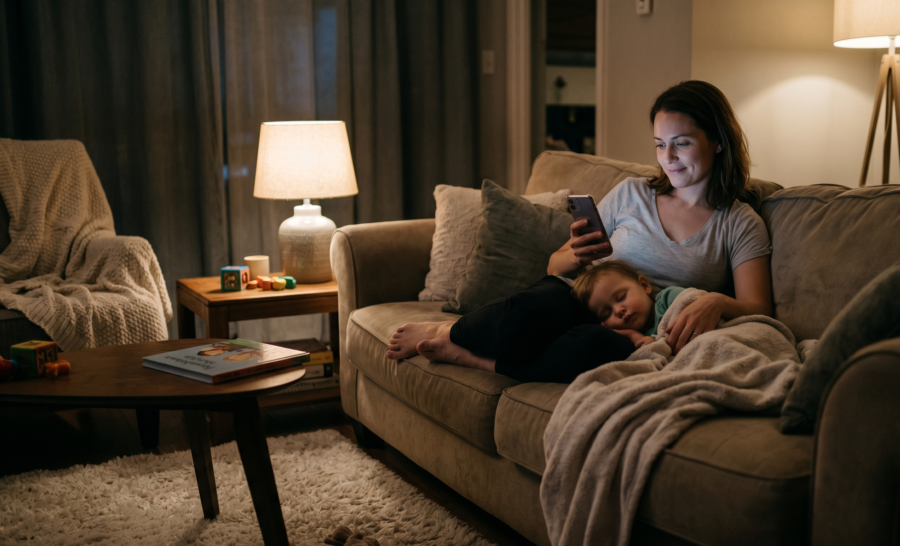
Most parents can recite their household screen time rules without pausing. One hour after school. No devices at the dinner table. Phones off an hour before bed. These limits exist because we understand, almost instinctively, that unstructured screen time tends to affect children’s sleep, mood, and focus.
And then the kids go to bed and we pick up the phone.
There is no judgement in that observation. Adults need downtime, and screens are a fast, low-effort way to access it. But the same logic that makes us careful about our children’s habits applies to our own, whether we acknowledge it or not. Unlimited, unplanned leisure time on a device does not automatically restore you; instead, it frequently leaves you more tired and more distracted, and quietly more frustrated with yourself.
The gap between the rules we set for children and the total absence of rules we apply to ourselves is worth examining. In an era where modern dynamics often blur boundaries—forcing us to navigate trends like child-led parenting—maintaining a little personal structure tends to make leisure more enjoyable, not less. Knowing you have an hour is more relaxing than vaguely scrolling until exhaustion forces you to stop.
How to Budget Your Leisure Time
Building a simple framework for your own downtime does not need to be complicated. The goal is not to schedule away all spontaneity. It is to give yourself enough structure that your rest actually feels like rest.
A straightforward approach that works for many parents:
- Pick one main activity per evening. Trying to fit in a show, a game session, some social media, and a few messages fragments your attention. One thing done well tends to be more satisfying.
- Set a time box before you start. Decide in advance whether you have thirty minutes or ninety. An alarm on your phone is perfectly reasonable and requires no willpower.
- Put a number on any spending. If your leisure activity involves any cost, decide the amount before opening the site or app, not in the moment.
- Build in at least one non-screen activity. Even ten minutes of reading, stretching, or simply sitting without a device helps signal to your nervous system that the day is actually ending.
- Track loosely. You do not need a spreadsheet. A rough sense of whether your habits have drifted in the last week is usually enough to self-correct.
The point is not perfection. It is intention. Choosing your leisure beats stumbling into it.
Tools That Do the Work for You
Willpower is a limited resource, especially at the end of a full parenting day. This is why built-in limits inside a platform tend to work better than personal resolve. When the structure is automatic, you do not have to keep making the same decision repeatedly.
We tested NV Casino and found that it handles this unusually well compared to many entertainment platforms. The site allows you to set deposit limits, session time limits, and spending caps directly from your account settings, and those limits apply immediately rather than after a cooling-off period. That matters because the most useful restriction is the one that is already in place before you start, not the one you try to remember to apply when you are tired and enjoying yourself.
Deposit limits cap how much you can add to your account in a day, week, or month. Session limits end your play automatically after a chosen duration. Together, they do most of the work that willpower is supposed to do, but without the friction. For a parent who wants to enjoy a genuine leisure option without any background anxiety about overdoing it, that kind of built-in accountability is worth looking for in any platform you use regularly.
Comparing Common Downtime Habits
Different leisure activities carry different costs in time, money, and how much attention they require. NVCasino sits in the middle of the range when compared to most common options, which is why it suits parents who want something engaging but controlled.
| Activity | Avg. time per session | Typical cost | Self-control tools |
| Streaming a show | 45 to 90 min | Low (subscription) | None built in |
| Social media | Unlimited | Free | Optional screen time app |
| Mobile games | 20 to 60 min | Free to variable | Minimal |
| Online casino (NVCasino) | 30 to 60 min | Variable, settable | Deposit and session limits |
| Audiobook or podcast | 20 to 45 min | Low | Natural stopping points |
| Reading | 20 to 60 min | Low | Natural stopping points |
The table is not a ranking. Every activity has its place depending on your mood and energy level. The useful insight is that controllability varies significantly, and choosing platforms and hobbies where limits are easy to apply tends to make the whole routine more sustainable.
Rounding Up
The screen rules you set for your children exist because you care about their wellbeing. Applying a similar thoughtfulness to your own downtime is not self-restriction. It is self-respect. Time-box your evenings, use platforms like NVCasino that give you built-in controls, and let your leisure time actually restore you. A well-rested parent is the best version of the job.
Vanessa Bartoletti
Wednesday 22nd of July 2026
Je serais ravi de vous faire une proposition.
ExoWatts
Monday 6th of July 2026
Great content! Keep up the good work!
Jocelyn2676
Wednesday 1st of July 2026
https://shorturl.fm/WHdIr